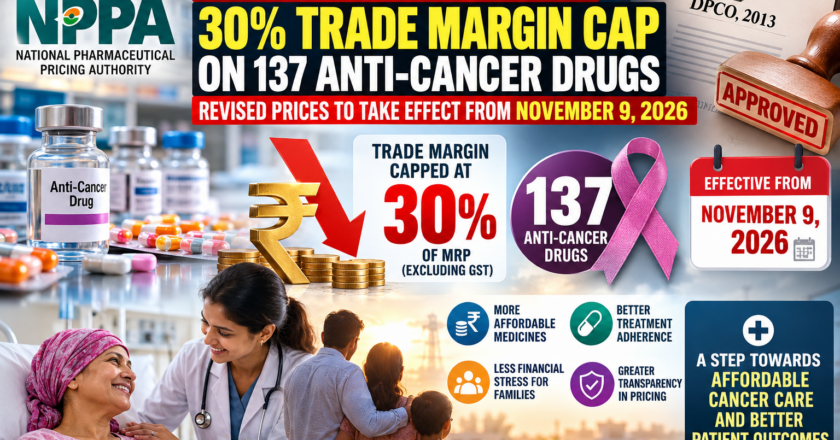
NPPA Approves 30% Trade Margin Cap on 137 Anti-Cancer Drugs; Revised Prices to Take Effect from November 9

Move under DPCO, 2013 aims to curb excessive trade mark-ups, improve affordability and ensure uninterrupted availability of essential cancer medicines

The National Pharmaceutical Pricing Authority (NPPA) has approved a trade margin rationalisation (TMR) mechanism for 137 non-scheduled anti-cancer drugs, capping trade margins at 30% of the maximum retail price (MRP), excluding GST. The revised prices will come into effect from November 9, 2026, and remain in force until further orders.

The revised prices of the identified non-scheduled anti-cancer drugs are expected to decrease by up to 70%, depending on their existing price structures. However, the actual reduction will vary from medicine to medicine.
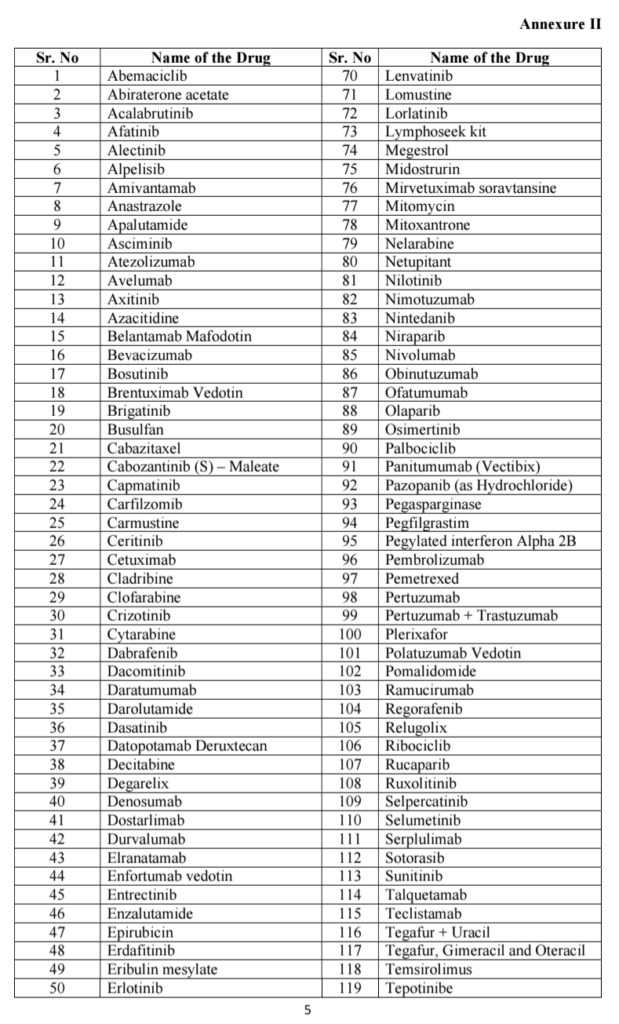
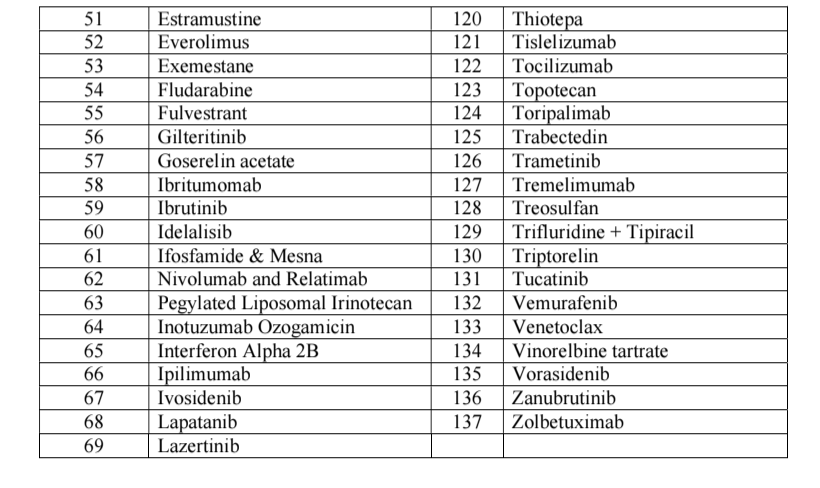
The decision was taken at the Authority’s 284th overall and 152nd meetings under the Drugs (Prices Control) Order (DPCO), 2013, held on October 16 and 17, 2026, under the chairmanship of Manoj Joshi, Secretary, Department of Pharmaceuticals and Chairman of NPPA.

The intervention will be implemented under Paragraph 19 of DPCO, 2013, which empowers the government to take action in extraordinary circumstances in the public interest.

Price cap to curb excessive trade mark-ups

According to the meeting minutes, the Authority considered the need to address excessive trade mark-ups on non-scheduled anti-cancer medicines, citing market evidence, public-health concerns and the precedent set by a similar intervention in 2019.

The Authority decided to limit the trade margin to 30% of the MRP, excluding GST. This corresponds to a mark-up of 42.86% on the price to stockist or price to distributor (PTS/PTD), allowing a reasonable margin for the trade while seeking to prevent excessive increases in retail prices.

The measure follows deliberations at the Authority’s previous meeting on October 8, 2026, and is based on recommendations from an expert committee of the Ministry of Health and Family Welfare, which identified 137 anti-cancer drugs for inclusion in the exercise.

The 137 identified medicines include immunotherapy drugs used to treat more than 20 types of cancer, as well as Denosumab, used by breast and prostate cancer patients; Pegfilgrastim, used to prevent neutropenia in cancer patients; and Bevacizumab, approved for the treatment of certain cancers, including colorectal, ovarian and cervical cancer. The PIB release also highlighted medicines such as Pembrolizumab, Durvalumab and Osimertinib, whose revised MRPs are expected to improve affordability for cancer patients.

March 2026 prices to serve as the reference

NPPA has approved a mechanism for calculating revised MRPs using PTS/PTD data for March 2026 as the reference.

The PTS/PTD will be calculated by dividing the manufacturer’s net sales realisation for the relevant product during the reference month by the total quantity sold. If a manufacturer recorded no sales during March 2026, the calculation will use sales data for the period from April 2025 to March 2026.

All categories of sales will be considered, except government sales.

For formulations launched after March 31, 2026, the revised MRP will be calculated using the current PTS/PTD. Where manufacturers supply medicines directly to hospitals or medical institutions, the institutions will be treated as stockists or distributors, and the manufacturer’s invoice data will be used for the calculation.

Higher-priced formulations must be reduced

Manufacturers selling branded or generic versions of the covered medicines at prices above the newly calculated MRP will be required to reduce their prices accordingly. Where an existing MRP is lower than the calculated price, the lower price must be maintained.

The order will also cover patented medicines, except where an exemption has been approved under Paragraph 32 of DPCO, 2013.

The price-control mechanism will apply to non-scheduled formulations containing any of the listed drugs, whether used individually or in combination. Its coverage will extend across strengths, dosage forms and routes of administration, including formulations used for therapeutic indications other than cancer.

Following publication of the notification in the Official Gazette, earlier price orders fixing ceiling prices or retail prices under the relevant provisions of DPCO, 2013, where applicable, will stand superseded as specified in the order.

Manufacturers given seven days to submit revised prices

Manufacturers will have seven days from publication of the order in the Official Gazette to submit revised MRP information to NPPA and the concerned State Drug Controller, whether or not the MRP changes.

Consumers can check the revised prices of medicines through the NPPA website and the Pharma Sahi Daam mobile application. Manufacturers must disseminate revised price lists to retailers and hospitals, while hospitals are required to ensure that the applicable reduced prices are implemented from November 9, 2026.

They must also issue and submit the revised price list in Form V through the Integrated Pharmaceutical Database Management System (IPDMS) and provide copies to State Drug Controllers, dealers and other relevant entities within the same period.

Failure to submit the required information will be treated as non-reduction of MRP and may lead to action to recover overcharged amounts under the applicable provisions of DPCO, 2013.Retailers, dealers, hospitals and medical institutions will be required to prominently display the applicable price lists and supplementary price lists.

Patient assistance programmes receive conditional exemption

The order provides for the exclusion of quantities supplied free of cost to patients under manufacturers’ Patient Assistance Programmes (PAP) from PTS/PTD and MRP calculations for trade-margin capping, subject to specified conditions.Manufacturers will have to furnish an undertaking to NPPA and maintain detailed patient records, including identity and residence documents, disease and prescription details, and records of medicines imported, received and consumed.

The medicines must be used exclusively for the specified purpose. NPPA will retain the authority to seek additional information, conduct audits and inspections, and verify programme implementation. Non-compliance may result in the relevant quantities losing the exemption.

Supply continuity and regulatory monitoringAlongside price regulation, NPPA has emphasised the need to maintain uninterrupted supplies of the covered medicines.

Manufacturers will be required to maintain current production levels. Any manufacturer proposing to reduce average monthly production must obtain prior permission from NPPA. Those intending to discontinue production or imports must submit the prescribed information in Form IV of Schedule II of DPCO, 2013, at least six months before the proposed discontinuation date.

Hospitals and medical institutions, which account for a substantial share of anti-cancer medicine purchases, have also been asked to monitor MRPs and report violations to NPPA.

State Drug Controllers will oversee compliance by manufacturers, dealers, hospitals and medical institutions. NPPA may initiate recovery proceedings in cases of overcharging.

Annual price increases remain subject to the cap

Manufacturers may continue to avail themselves of annual price increases under Paragraph 20(1) of DPCO, 2013, provided they remain compliant with the maximum permissible trade margin specified in the order.

The measure represents a significant regulatory intervention in the non-scheduled anti-cancer medicines segment, seeking to balance reasonable trade margins with patient affordability and reliable medicine supplies.

The revised prices are scheduled to take effect on November 9, 2026, subject to publication of the order in the Official Gazette and the requirements specified therein.

A Step Towards Affordable Cancer Care and Better Patient Outcomes

Beyond price regulation, this decision could bring meaningful relief to cancer patients and their families, who often face substantial financial hardship during prolonged treatment. More affordable medicines may help patients adhere to prescribed treatment, reduce the likelihood of interruptions due to financial constraints, and ease the emotional and economic stress experienced by caregivers. The initiative could also promote greater transparency in medicine pricing and strengthen public confidence in the healthcare system. However, its real impact will depend on effective implementation, actual reductions in the prices of individual medicines, and consistent availability across hospitals, pharmacies and rural healthcare facilities. Ultimately, the move reinforces the principle that access to essential cancer treatment should not be determined solely by a patient’s financial circumstances, but should remain a priority in the pursuit of equitable, compassionate and patient-centred healthcare.
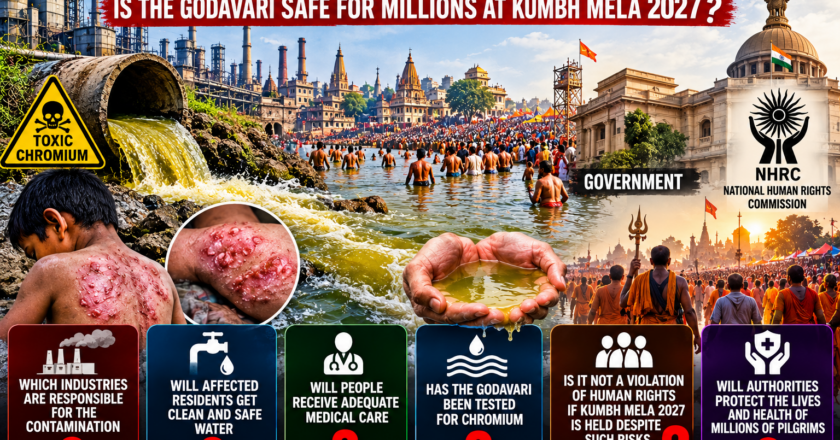
नासिक में जहरीले क्रोमियम का खतरा: क्या 2027 के कुंभ में सुरक्षित होगा गोदावरी का जल?

NCIB News | रिपोर्टर: मनीष जैन

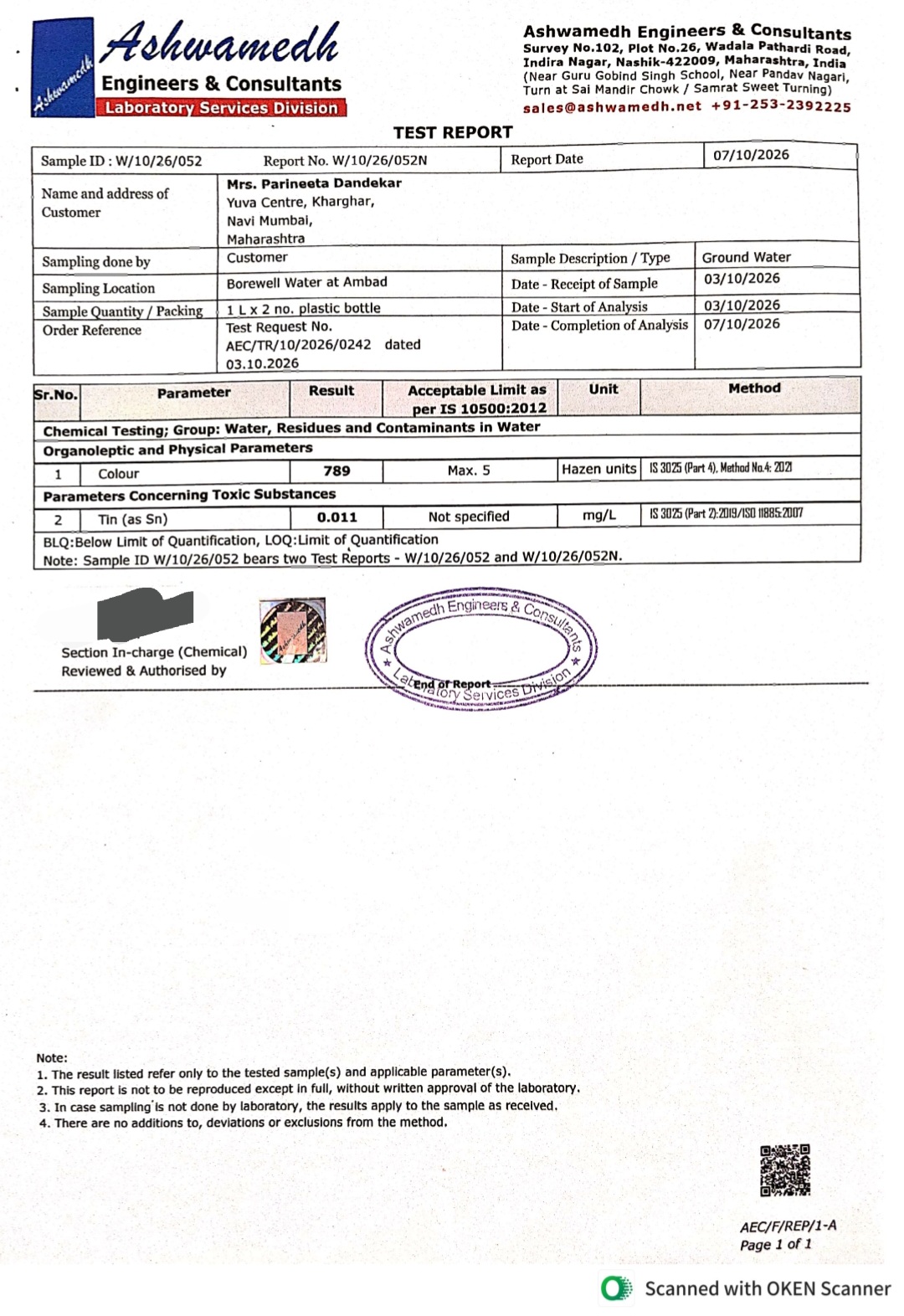
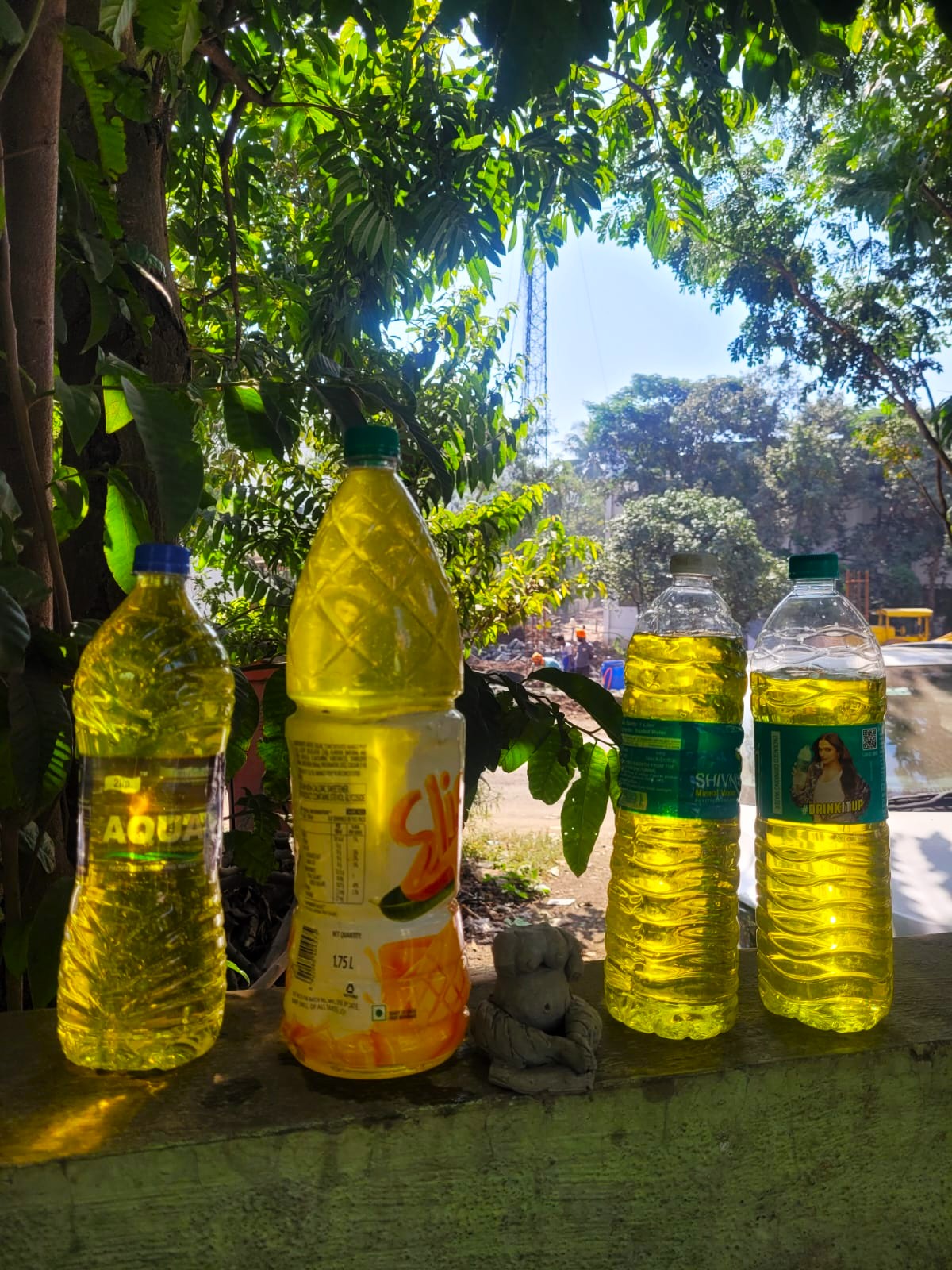
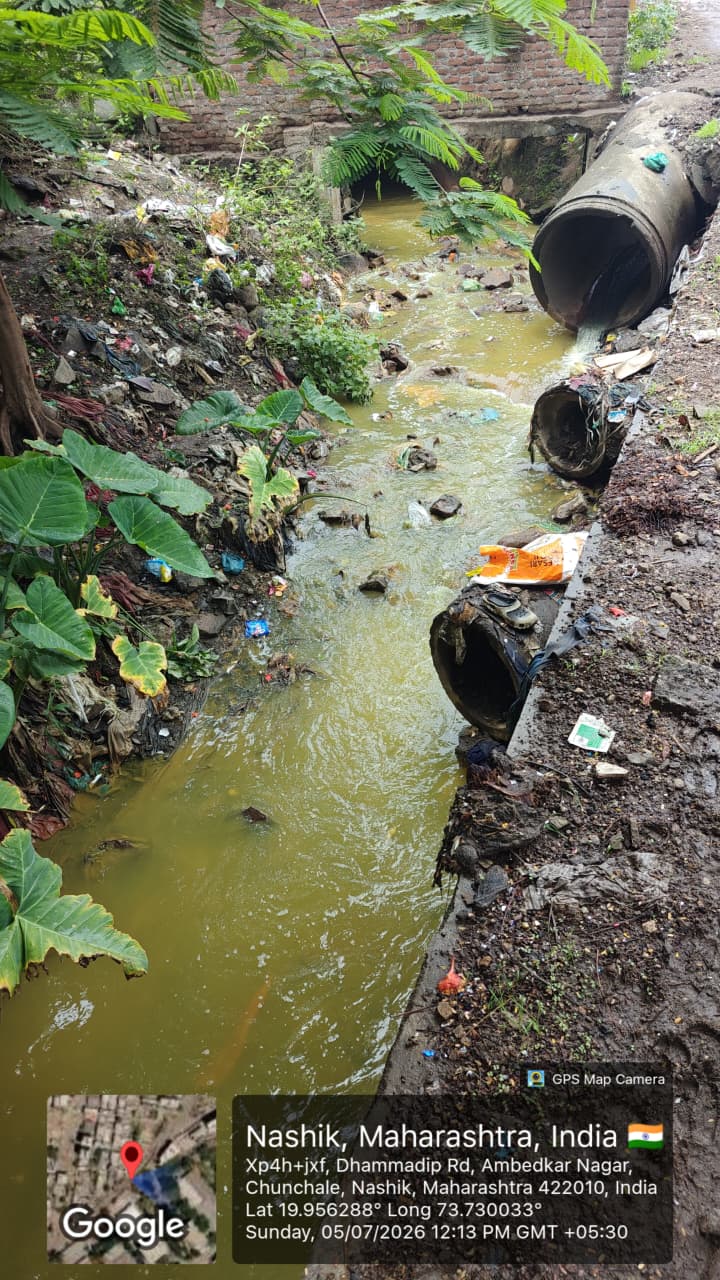
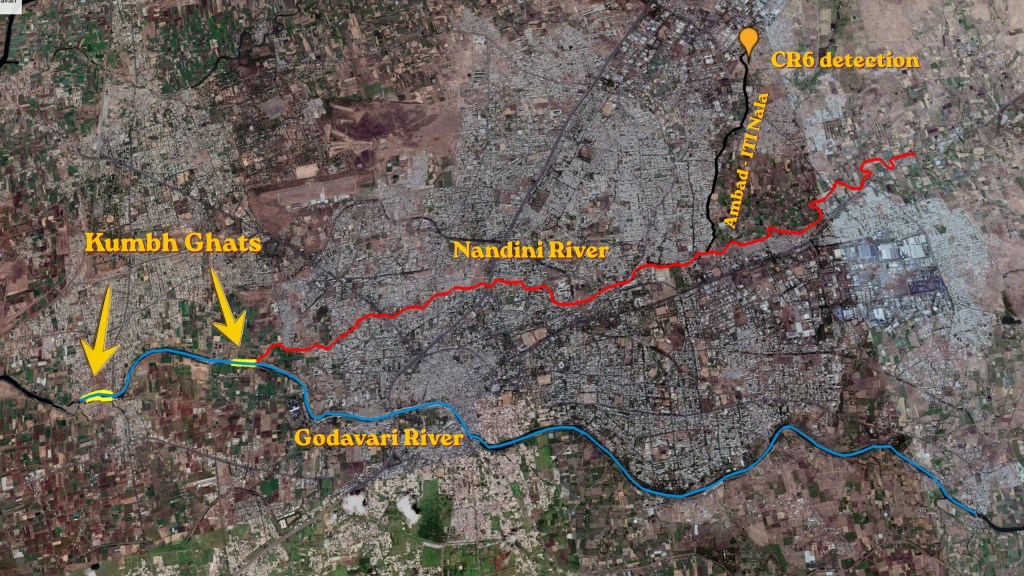
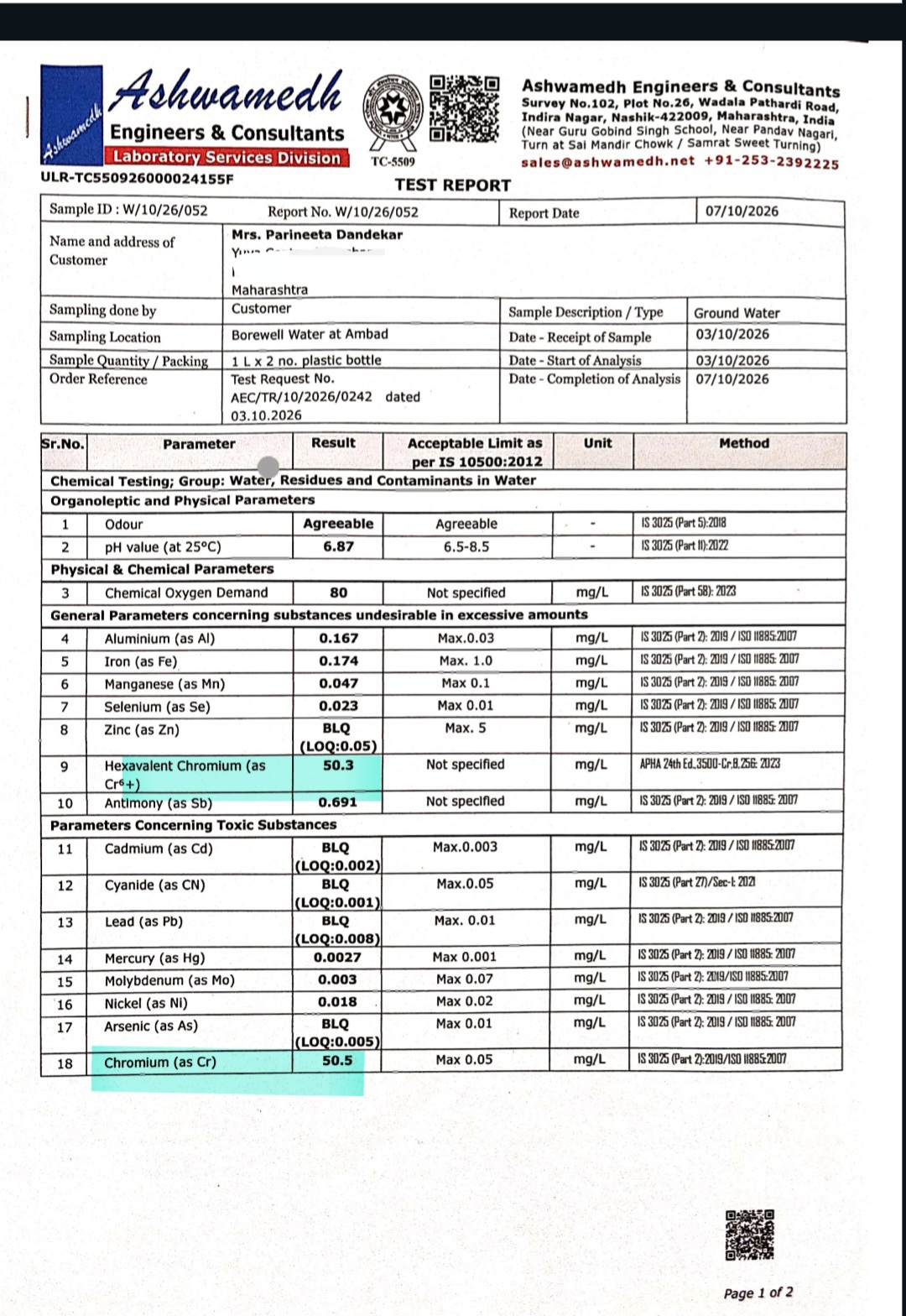
नासिक, 15 अक्टूबर 2026: वर्ष 2027 में प्रस्तावित सिंहस्थ कुंभ मेले से पहले नासिक में भूजल में जहरीले क्रोमियम की अत्यधिक मात्रा मिलने की खबर ने गंभीर चिंता पैदा कर दी है। दक्षिण एशिया नेटवर्क ऑन डैम्स, रिवर्स एंड पीपल (SANDRP) की 8 अक्टूबर 2026 की प्रेस विज्ञप्ति के अनुसार, अंबड औद्योगिक क्षेत्र के दत्तानगर में आवासीय बोरवेल के पानी में क्रोमियम का खतरनाक स्तर पाया गया है। संगठन ने यह भी आरोप लगाया है कि दूषित पानी एक स्थानीय नाले के माध्यम से कुंभ मेले के स्नान घाट के पास गोदावरी नदी में पहुंच रहा है।

प्रेस विज्ञप्ति में प्रस्तुत आंकड़े बेहद चिंताजनक हैं। SANDRP के अनुसार, एक मान्यता प्राप्त प्रयोगशाला में जांच के दौरान पानी में हेक्सावैलेंट क्रोमियम 50.3 मिलीग्राम प्रति लीटर और कुल क्रोमियम 50.5 मिलीग्राम प्रति लीटर पाया गया। कुल क्रोमियम की यह मात्रा भारतीय मानक ब्यूरो (BIS) द्वारा निर्धारित पेयजल की 0.05 मिलीग्राम प्रति लीटर की अधिकतम स्वीकार्य सीमा से लगभग 1,010 गुना अधिक है।

इन निष्कर्षों ने औद्योगिक प्रदूषण पर नियंत्रण, स्थानीय नागरिकों के स्वास्थ्य और आगामी कुंभ मेले में श्रद्धालुओं की सुरक्षा को लेकर गंभीर सवाल खड़े कर दिए हैं। हालांकि, भूजल में दर्ज क्रोमियम की मात्रा को सीधे गोदावरी नदी के पानी की मात्रा नहीं माना जा सकता। नदी और प्रत्येक स्नान घाट की वास्तविक स्थिति का पता प्रयोगशाला जांच से ही लगाया जा सकता है।

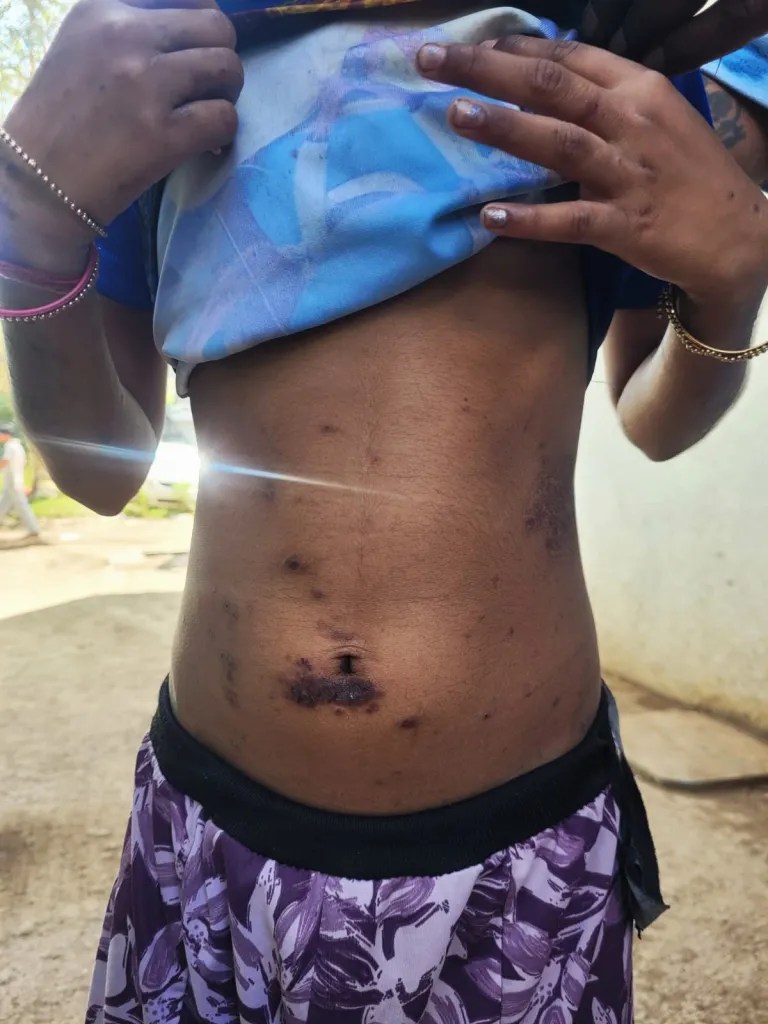
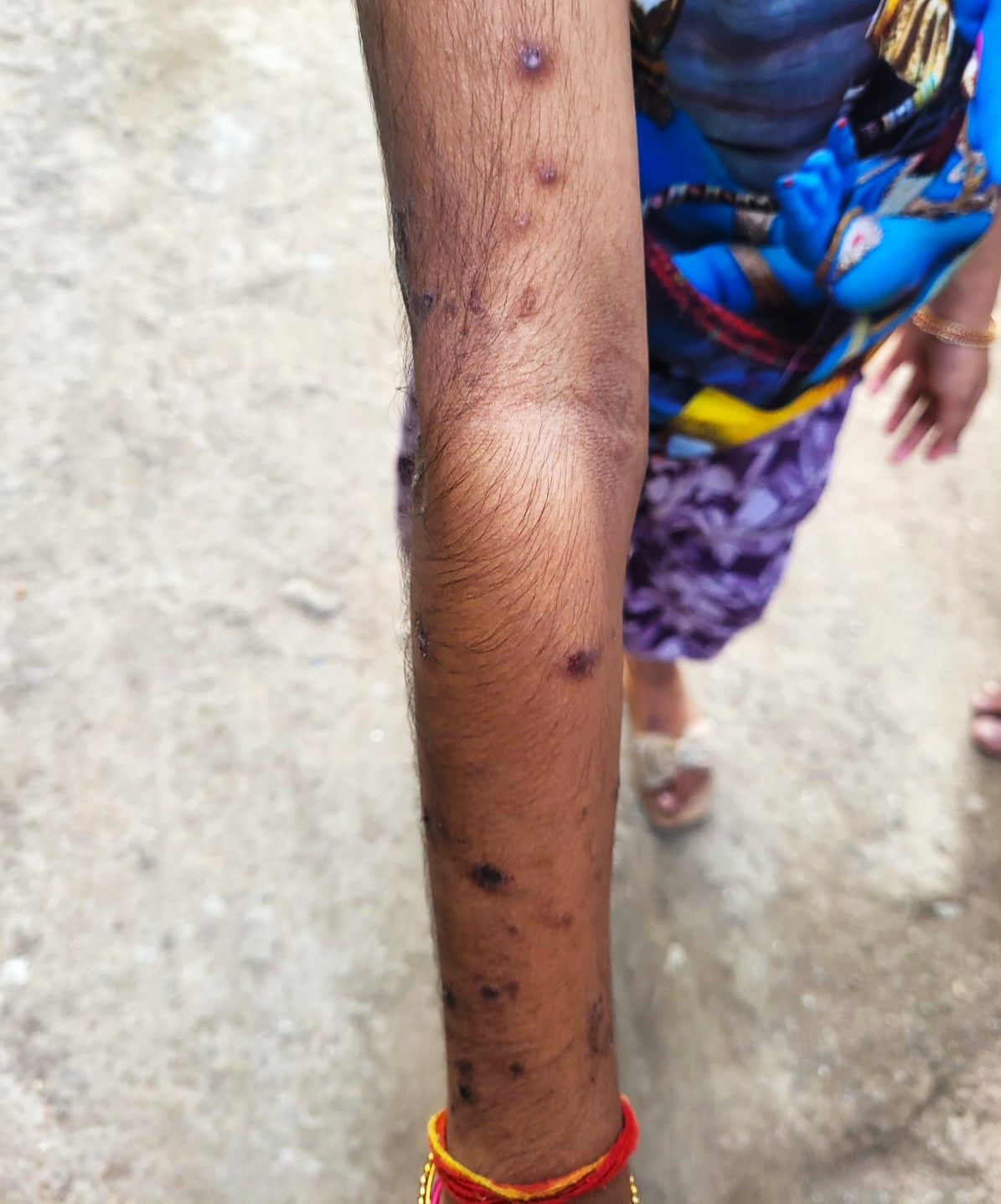
बच्चों के शरीर पर छाले और त्वचा पर गंभीर घाव होने की शिकायत

SANDRP की प्रेस विज्ञप्ति के अनुसार, दूषित पानी के संपर्क में आने वाले लोगों ने त्वचा पर चकत्ते, छाले और धीरे-धीरे भरने वाले गहरे घाव होने की शिकायत की है। संगठन ने बच्चों के शरीर पर व्यापक त्वचा संबंधी चोटें देखे जाने का उल्लेख किया है। इसके अलावा, कुछ लोगों में लिम्फ नोड्स में सूजन और अन्य स्वास्थ्य समस्याओं की भी जानकारी दी गई है।

SANDRP का आरोप है कि नगर निगम की ओर से पानी की अपर्याप्त और अनियमित आपूर्ति के कारण कुछ परिवार नहाने, कपड़े धोने और बर्तन साफ करने के लिए भी बोरवेल के पानी पर निर्भर हैं। संगठन के मुताबिक, कुछ कामकाजी परिवार अपनी मासिक आय का लगभग आधा हिस्सा इलाज, घावों की ड्रेसिंग और वैकल्पिक आवास पर खर्च कर रहे हैं।

प्रेस विज्ञप्ति में प्रभावित बस्ती की दो महिलाओं के गर्भपात होने की भी जानकारी दी गई है। हालांकि, इन घटनाओं और क्रोमियम के संपर्क के बीच प्रत्यक्ष कारणात्मक संबंध स्थापित नहीं हुआ है। इसके लिए उचित चिकित्सकीय जांच आवश्यक है।

गोदावरी नदी तक प्रदूषण पहुंचने की आशंका

आगामी कुंभ मेले के संदर्भ में सबसे गंभीर चिंता SANDRP का यह आरोप है कि दूषित पानी एक स्थानीय नाले के जरिए गोदावरी नदी में पहुंच रहा है। संगठन के अनुसार, यह नाला कुंभ मेले के एक स्नान घाट के पास नदी में मिलता है।

SANDRP ने महाराष्ट्र प्रदूषण नियंत्रण बोर्ड (MPCB) से नंदिनी नदी/धारा और संदिग्ध प्रदूषण स्थल के नीचे गोदावरी के पानी की तत्काल जांच करने की मांग की है। संगठन ने यह भी कहा है कि प्रदूषण कितनी दूर तक फैला है, इसका पता लगाया जाए और आवश्यकता पड़ने पर नदी के निचले हिस्सों में रहने वाले लोगों तथा अन्य जल उपयोगकर्ताओं को सतर्क किया जाए।

प्रेस विज्ञप्ति में गोदावरी नदी के पानी में क्रोमियम की वास्तविक मात्रा का कोई प्रयोगशाला परिणाम नहीं दिया गया है। इसलिए यह अभी स्थापित नहीं है कि नदी के किन-किन हिस्सों, स्नान घाटों या तालाबों में प्रदूषण मौजूद है। इसकी पुष्टि वैज्ञानिक जांच से होनी आवश्यक है।

औद्योगिक इकाइयों और सरकारी कार्रवाई पर सवाल

SANDRP ने आरोप लगाया है कि पीले रंग के पानी की खबरें सामने आने के बाद महाराष्ट्र प्रदूषण नियंत्रण बोर्ड ने 30 सितंबर 2026 को केवल एक कंपनी को कारण बताओ नोटिस जारी किया था। संगठन ने पानी की जांच के नतीजों को सार्वजनिक नहीं किए जाने पर भी सवाल उठाए हैं।

संगठन ने अंबड औद्योगिक क्षेत्र में इलेक्ट्रोप्लेटिंग, मेटल फिनिशिंग, पेंट और अन्य संभावित प्रदूषणकारी उद्योगों की व्यापक जांच कराने की मांग की है। इसके अलावा, सभी जांच रिपोर्ट सार्वजनिक करने, दूषित पानी की आपूर्ति रोकने और पर्यावरणीय सुधार के लिए प्रभावी कदम उठाने की मांग की गई है।

प्रदूषण का वास्तविक स्रोत, पर्यावरण को हुए नुकसान की सीमा और संबंधित अधिकारियों की कार्रवाई की पर्याप्तता की जांच सक्षम प्राधिकारियों द्वारा की जानी आवश्यक है।

क्या असुरक्षित स्नान व्यवस्था मानवाधिकारों का सवाल बन सकती है?

भारतीय संविधान के अनुच्छेद 21 के तहत जीवन के अधिकार की न्यायिक व्याख्या में स्वास्थ्य और स्वच्छ पर्यावरण से जुड़े महत्वपूर्ण संरक्षण शामिल हैं। सार्वजनिक स्वास्थ्य की रक्षा करना और पर्यावरणीय नुकसान को रोकना भी सरकार की जिम्मेदारियों में आता है।

यदि वैज्ञानिक जांच से यह स्थापित होता है कि कोई निर्धारित स्नान घाट गंभीर स्वास्थ्य जोखिम पैदा करता है, तो पर्याप्त चेतावनी और सुरक्षा उपायों के बिना लोगों को वहां स्नान करने देना मानवाधिकार और सार्वजनिक कानून से जुड़े गंभीर सवाल खड़े कर सकता है।

हालांकि, केवल भूजल के इन आंकड़ों के आधार पर यह निष्कर्ष नहीं निकाला जा सकता कि पूरी गोदावरी नदी या कुंभ मेले के सभी स्नान घाट दूषित हैं। मुख्य सवाल यह है कि क्या सरकार व्यापक जांच कराएगी, परिणाम सार्वजनिक करेगी और जहां गंभीर जोखिम सामने आएगा, वहां समय रहते उचित कार्रवाई करेगी।

क्या लाखों श्रद्धालुओं के पहुंचने से पहले सरकार सभी निर्धारित स्नान घाटों की सुरक्षा प्रमाणित करेगी, या कुंभ मेले के नजदीक आने तक पानी की गुणवत्ता से जुड़े महत्वपूर्ण सवाल अनुत्तरित रहेंगे?

सुरक्षित स्नान व्यवस्था पहले से सुनिश्चित करना जरूरी

SANDRP ने संदिग्ध नाले, नंदिनी नदी/धारा और गोदावरी के संबंधित हिस्सों की तत्काल जांच की मांग की है। सभी निर्धारित स्नान घाटों की स्वतंत्र जांच और परिणामों को सार्वजनिक करना वास्तविक जोखिम का आकलन करने के लिए आवश्यक होगा।

यदि किसी स्थान पर पानी असुरक्षित पाया जाता है, तो धार्मिक भावनाओं का सम्मान करते हुए वहां स्नान पर उचित प्रतिबंध और सुरक्षित वैकल्पिक व्यवस्थाओं पर विचार किया जाना चाहिए।

प्राथमिकता प्रभावित परिवारों को सुरक्षित पानी और चिकित्सा सहायता उपलब्ध कराने, प्रदूषण के स्रोत की पहचान कर उसे रोकने, गोदावरी की वास्तविक स्थिति का पता लगाने और वैज्ञानिक प्रमाणों के आधार पर जनसुरक्षा सुनिश्चित करने की होनी चाहिए।

2027 के सिंहस्थ कुंभ मेले की तैयारियों के बीच सबसे महत्वपूर्ण सवाल यही है कि क्या प्रशासन समय रहते पारदर्शी और वैज्ञानिक प्रमाणों के साथ यह सुनिश्चित कर पाएगा कि श्रद्धालुओं को ऐसे स्वास्थ्य जोखिमों का सामना न करना पड़े, जिन्हें रोका जा सकता है।

FSSAI Proposes Ban on Use of ‘Paneer’ Label for Non-Milk Products, Seeks to Prevent Consumer Confusion

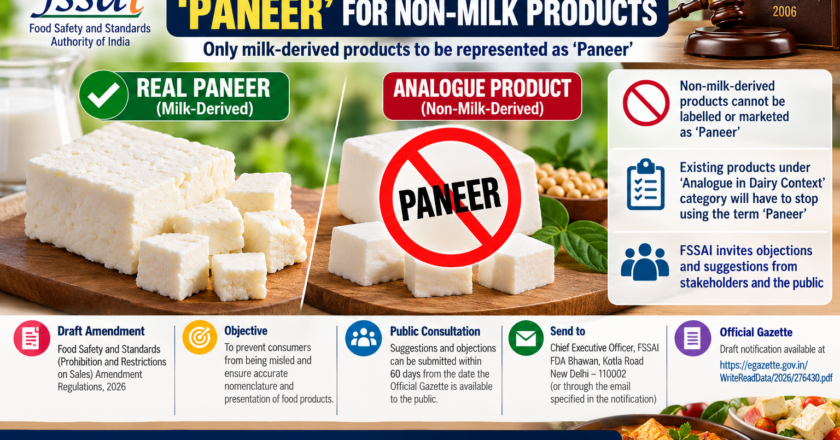
New Delhi, September 24, 2026: The Food Safety and Standards Authority of India (FSSAI) has proposed a significant amendment to food safety regulations aimed at preventing non-milk-derived analogue products from being marketed or labelled as “Paneer.”

The proposed Food Safety and Standards (Prohibition and Restrictions on Sales) Amendment Regulations, 2026 seek to specifically address products described as “paneer” despite being made from constituents that are not derived from milk.

Only milk-derived products to be represented as ‘Paneer’

Under the proposed amendment, a new clause would be inserted under Regulation 2.1.1 of the existing Food Safety and Standards (Prohibition and Restrictions on Sales) Regulations, 2011.

The amendment would cover “paneer made of constituents not derived from milk.” Products that are already licensed or registered under the ‘Analogue in Dairy Context’ category would have to discontinue the use of the term “Paneer” in their nomenclature, labelling and marketing.

The move is aimed at ensuring that consumers can clearly distinguish between genuine milk-derived paneer and products made using non-milk ingredients.

Focus on informed consumer choiceFSSAI’s proposal comes against the backdrop of growing availability of dairy analogues and plant- or non-milk-based products in the food market. While such products may have their own legitimate uses and markets, the proposed regulatory change focuses on how they are described and presented to consumers.

According to FSSAI, the nomenclature and presentation of food products should accurately reflect their nature and composition. The proposed restriction is therefore intended to reduce the possibility of consumers purchasing a non-milk product believing it to be conventional paneer.

Existing analogue products could face labelling changes

An important aspect of the proposal is its impact on products already licensed or registered in the ‘Analogue in Dairy Context’ category. If the amendment is finalised in its proposed form, such products would no longer be able to use “Paneer” as part of their nomenclature, labelling or marketing.

This could require manufacturers and food businesses to review product names, packaging and promotional material to ensure compliance with the amended regulations.

Public invited to submit objections and suggestions

The amendment is still at the draft stage and has not yet become a final regulation. FSSAI has invited objections and suggestions from stakeholders as well as members of the public.

The draft will be considered after the expiry of 60 days from the date copies of the relevant Official Gazette notification are made available to the public.

Suggestions and objections may be submitted to the Chief Executive Officer, FSSAI, FDA Bhawan, Kotla Road, New Delhi–110002, or through the email address specified in the notification.

What the proposal could mean for consumers

If ultimately notified in its proposed form, the amendment would establish a clearer distinction in the marketplace between milk-derived paneer and non-milk-derived analogue products.

For consumers, the intended effect is straightforward: the name and presentation of a food product should provide a clearer indication of what it actually contains, allowing purchasing decisions to be based on accurate information.

The proposal has been issued by FSSAI with the previous approval of the Central Government under the Food Safety and Standards Act, 2006. The principal Prohibition and Restrictions on Sales Regulations were notified in 2011 and have been amended periodically.

The proposal remains subject to the consultation process, and its final provisions may differ from the draft.

Medical Associations Object to NEET-PG 2025 Cut-off Reduction Following NBEMS Notification

January 14, 2026

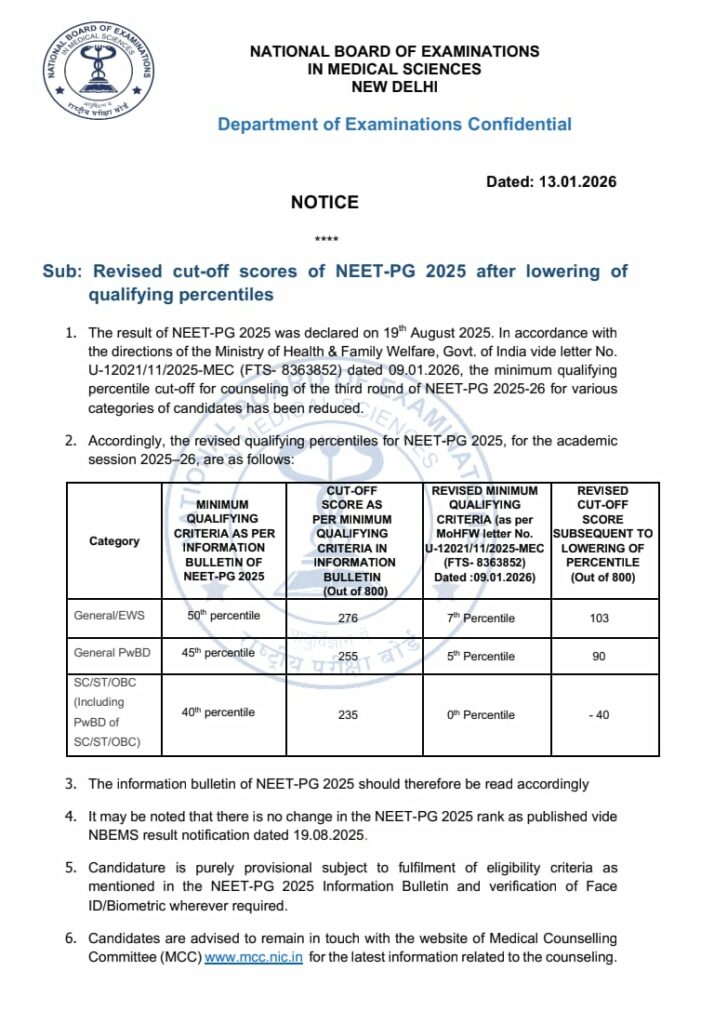
The decision to reduce the qualifying cut-off scores for NEET-PG 2025 has drawn strong objections from national medical associations, following a notification issued by the National Board of Examinations in Medical Sciences (NBEMS) on 13 January 2026.

NBEMS

According to the NBEMS notice, issued on the directions of the Ministry of Health & Family Welfare, the minimum qualifying percentiles for participation in the third round of NEET-PG 2025–26 counselling have been reduced across categories. The revised criteria allow eligibility at the 7th percentile for General/EWS candidates, 5th percentile for General PwBD, and 0th percentile for SC/ST/OBC candidates, with the corresponding cut-off score for the latter category being minus 40 marks out of 800.

NBEMS clarified that there is no change in NEET-PG 2025 ranks as declared on 19 August 2025 and that candidature remains subject to eligibility verification as per the NEET-PG Information Bulletin.

FORDA Raises Concerns on Merit and Training Standards

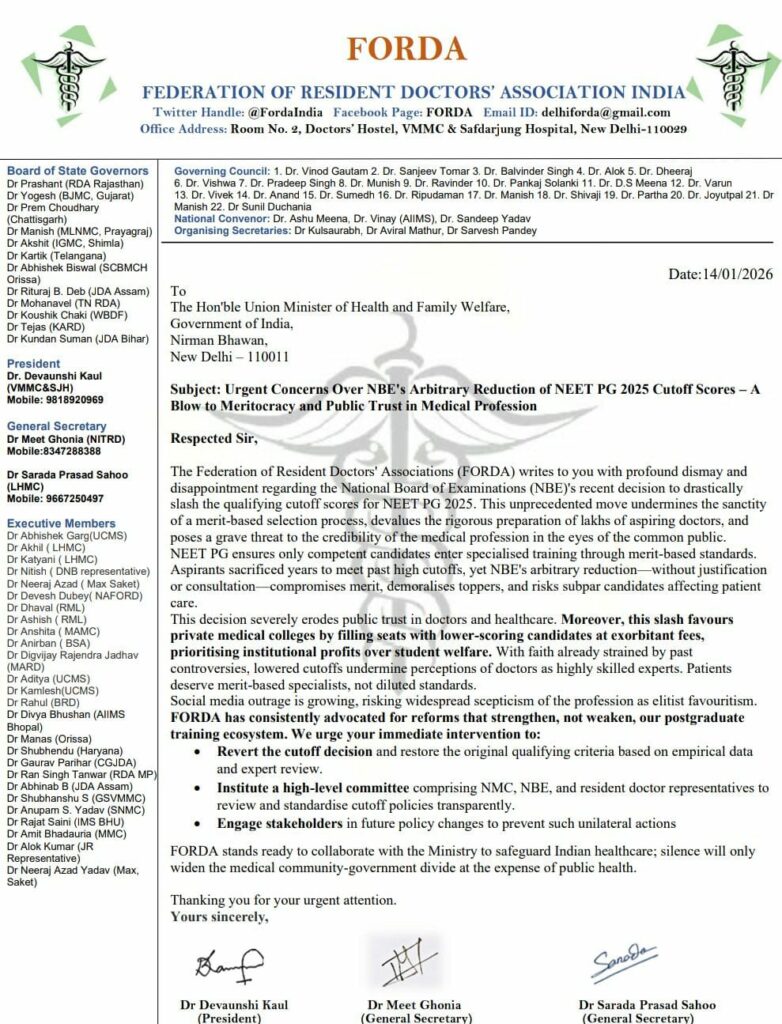
The Federation of Resident Doctors’ Associations (FORDA), in a letter addressed to the Union Minister of Health and Family Welfare dated 14 January 2026, expressed “profound dismay and disappointment” over the reduction of cut-off scores.

FORDA

FORDA stated that NEET-PG is intended to ensure merit-based entry into postgraduate medical education and that the sudden lowering of qualifying criteria, without stated academic justification or stakeholder consultation, undermines the credibility of the examination process. The association highlighted that aspirants prepare for years to meet qualifying standards and that such revisions adversely affect confidence in the system.

The letter further stated that diluted qualifying thresholds raise concerns regarding the quality of postgraduate medical training and may affect public trust in the medical profession.

FAIMA Demands Withdrawal of Notification

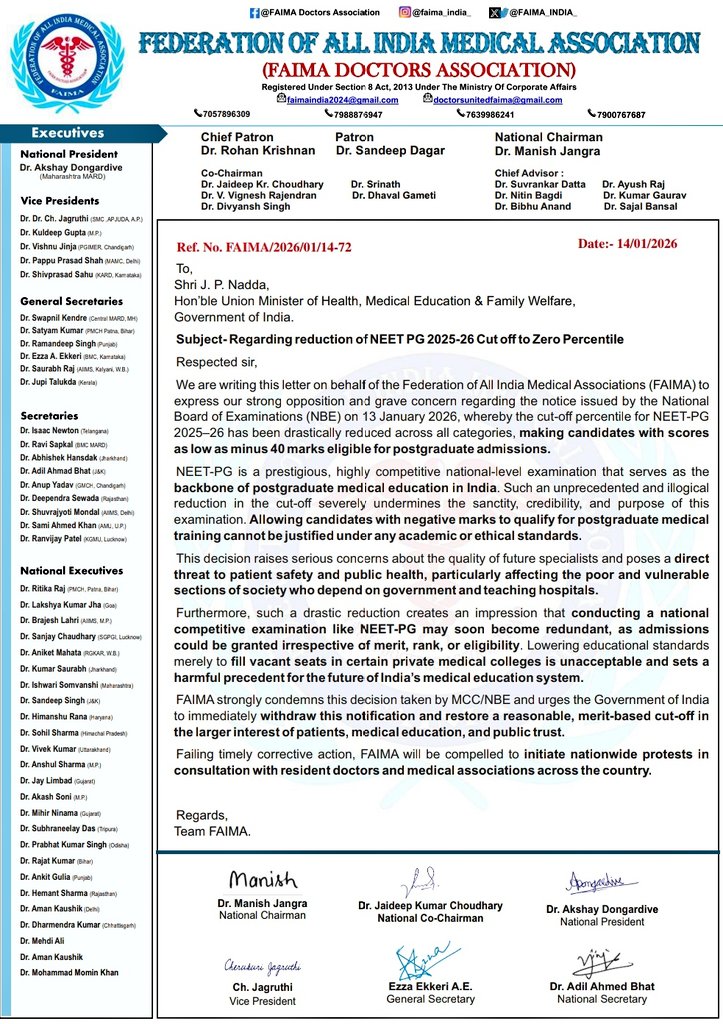
Separately, the Federation of All India Medical Associations (FAIMA) also objected to the NBEMS notification through a formal representation dated 14 January 2026.

FAIMA

FAIMA described the reduction of the cut-off to zero percentile as unprecedented and stated that permitting candidates with negative marks to qualify for postgraduate medical education cannot be justified on academic or ethical grounds. The association expressed concern regarding implications for patient safety and public health, particularly in teaching and government hospitals.

FAIMA urged the Government of India to withdraw the notification and restore a merit-based qualifying cut-off. The association also stated that it may initiate nationwide protests if corrective action is not taken.

Call for Review

Both FORDA and FAIMA have sought intervention from the Union Health Ministry and have requested a review of the revised cut-off decision in the interest of maintaining standards in postgraduate medical education.